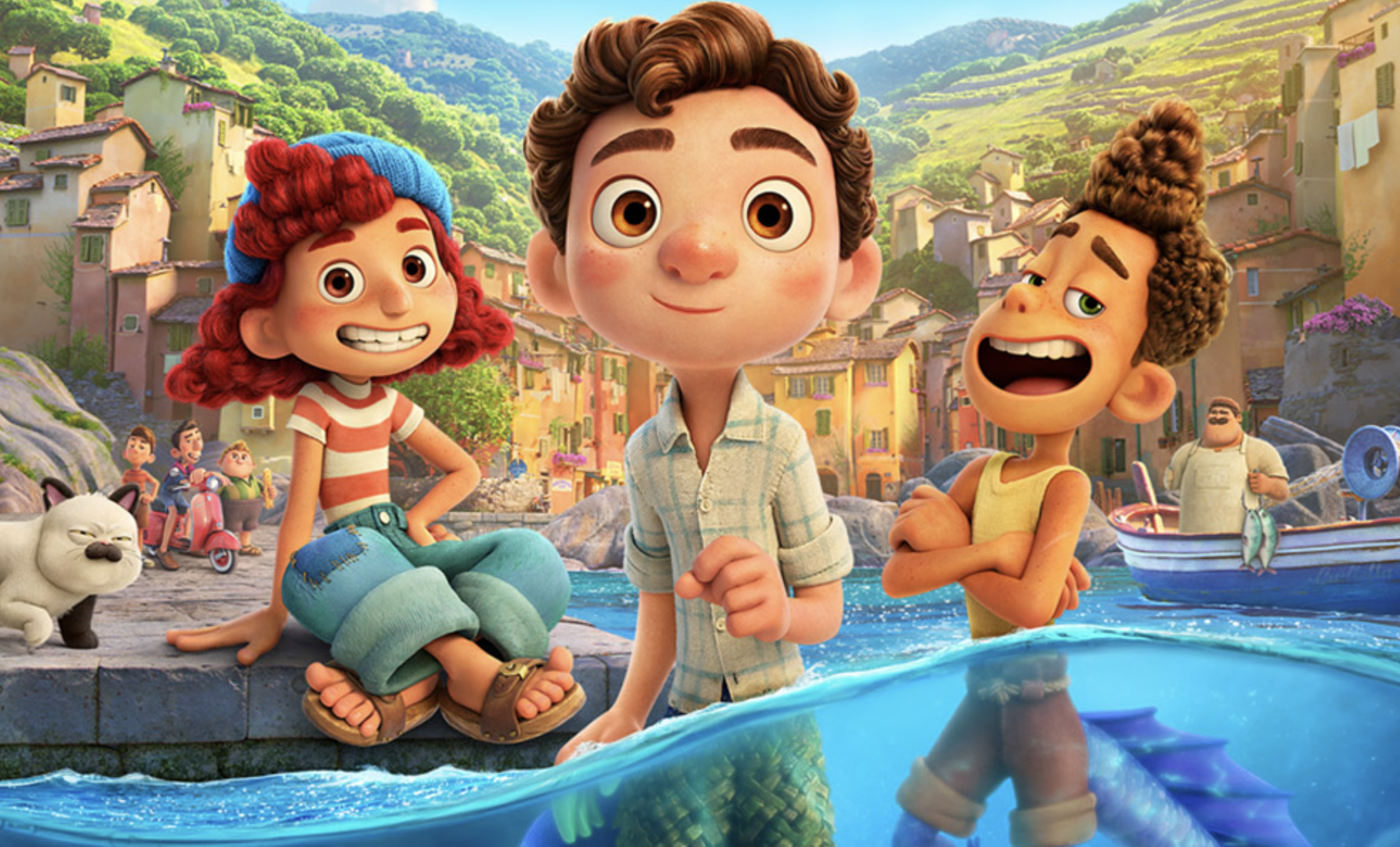

The entertainment industry (like the rest of the world) suffered tremendous disruption from the COVID pandemic. There was a major shift in the distribution of movies. Films that were initially slated for theaters were diverted to streaming platforms. Luca, a Pixar film from Disney, was one of those films. It’s been a long time coming, but now the movie is getting its chance in the sun with a release on the big screen.
Luca is upbeat, vividly animated, and with enchanting music that makes it a great choice for a family movie. It’s no surprise that the pasta-filled film was nominated for an Academy Award. As a whole, the movie works, even if it’s a little too briskly paced at times.
Luca is the story of a young sea monster named Luca (voiced by Pete the Cat’s Jacob Tremblay). On land with big Vespa-related dreams, Luca meets a fellow sea monster in human form, Alberto (Jack Dylan Grazer), and the two become fast friends on the adventure of a lifetime in the town of Portorosso and beyond. Both a slice-of-life and coming-of-age film, it is a lighthearted story with friendship at its core. At the movie’s end, viewers will find the courage to silenzio their inner Bruno and perhaps even feel a little less lonely. Luca is a deeply sweet story and also literally a fish, excuse me, sea monster out of water adventure.
Thematically and practically, there are some similarities to 2023’s Ruby Gillman, Teenage Kraken. But that’s inevitable when you’re dealing with “monsters” who live under the sea. (Anyone feeling the urge to watch The Little Mermaid again?) As sailors would say, it’s a tale as old as time. Luca is reportedly drawn from the storytelling of Italian folklore and mythology, along with the childhood friendships of director Enrico Casarosa on the Italian Coast. At the beginning of the film, there are some nods to that, with rowboat sailors and pirate-looking maps with illustrations of giant tentacled sea creatures.
Luca also sets up these different worlds that our protagonist, by the same name, journeys through – the land and the sea- in an easy-to-understand way. We can empathize with the boy who wants more than tending to his school of branzinos. The movie appropriately captures the fear of the unknown (and Luca’s fear of The Deep) while also capturing the spirit of adventure and growth that are hallmarks of coming-of-age stories. Screenwriters Mike Jones (of Soul) and Jesse Andrews capture the lightness and the seriousness needed for such a whimsical tale with expert skill.
Because this is Pixar, going into Luca, there’s already a high level of expectation for the animation. But Luca exceeds that by leaps and bounds. Both the character designs and the designs of the Italian Riviera world themselves are gorgeous, but the lighting of all of them gives the film extra warmth. It feels like summer and the Mediterranean, and everything is just more vivid and real. There is an almost poetic lyricism to the animation – it’s bursting with emotion. Some of the landscapes are reminiscent of Hayao Miyazaki, especially in Porco Rosso and Future Boy Conan. But don’t worry, there are no pilots turned pigs in this film. Just one very suspicious cat named Machiavelli.
Luca captures innocence and wonders in a heartfelt way. There’s a sequence when Luca is learning about space and the world from Giulia (Emma Berman), and finding out that it’s quite different from the fish-filled sky picture his friend Alberto has painted for him. It is surreal and simply stunning. The animation, from friends traipsing across a moonlit bridge to Luca’s imaginings of his own dance through the rings of Saturno, is alive with imagination.
Like John Powell’s score for Universal’s Migration, Luca’s score and music complements the film’s world-building and carefree sensibility. Dan Romer, who scored the epic and awards-overlooked Mads Mikkelsen drama vehicle The Promised Land, brightly brings Luca’s music to life. Romer nails translating the sunny-blue skies and warm emerald blue and green waters to music, with what feels like to my American ear, classic Italian musical influence. What’s especially notable is the difference between the music on the shore versus the music we hear with Luca’s parents and the underwater sequences. If you close your eyes, you can tell if you’re above or below the water based on the music. The score transports you to the world and is essential to the magic of Luca.
Ultimately, Luca is worth watching on the big screen as a family, especially if you dream of warmer days. The lighthearted fantasy shows the power of friendships and stepping outside of your comfort zone. After all, who hasn’t had the thought that Vespa is freedom? (Least of all, Audrey Hepburn in Roman Holiday.) It is a handcrafted tale enough to bring pasta and light to the loneliest fish in The Deep.
Luca is now in theaters and streaming on Disney+.


