
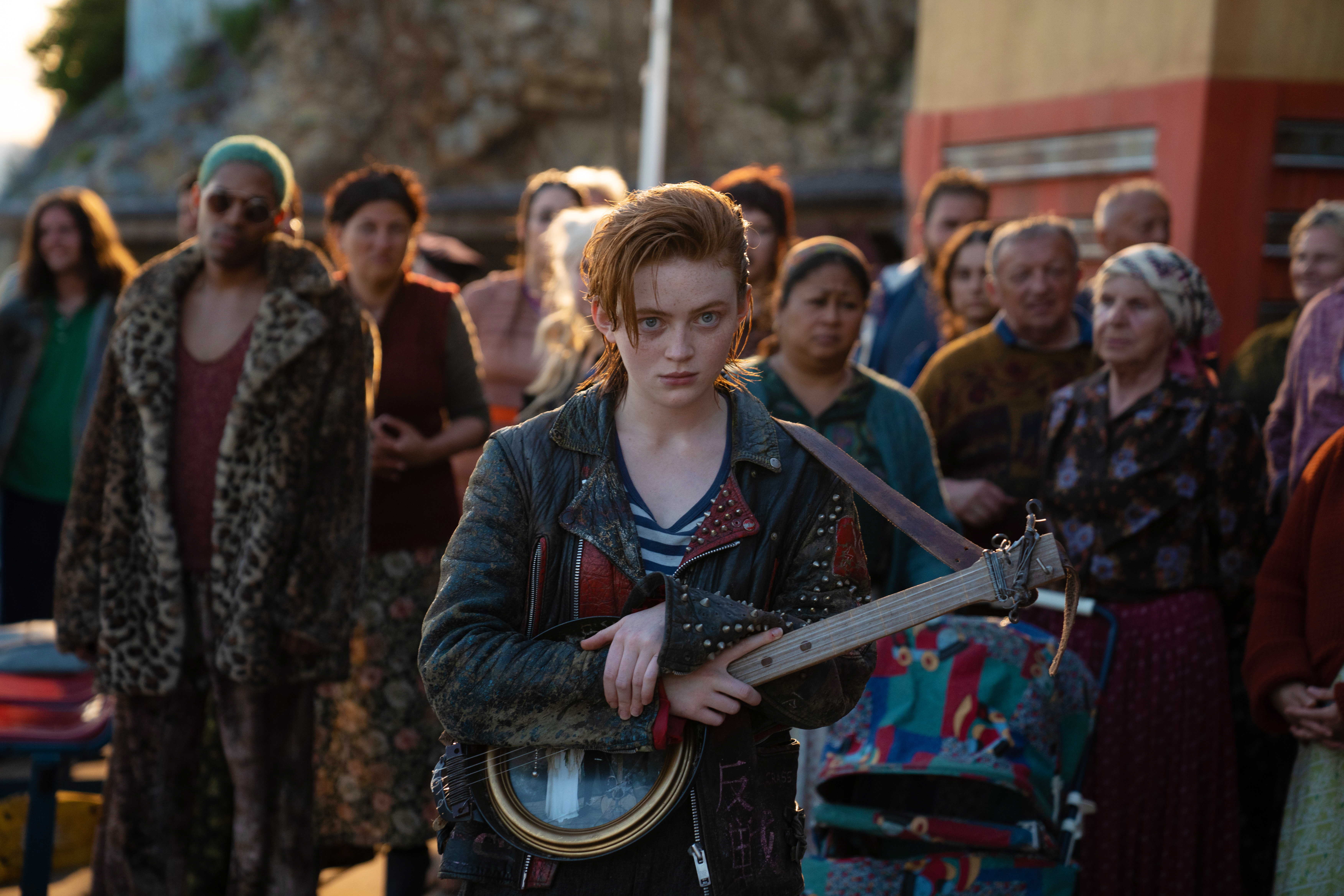
Full disclosure: This review was written by a big musical fan. Top Hat. Brigadoon. Singin’ in the Rain. The Band Wagon. West Side Story. Xanadu. Dilwale Dulhania Le Jayenge. A few masterpieces are named here, but I eat it all up. The kookier and more out-of-the-box it gets, the better. Yet, why did I want everyone in Geremy Jasper’s O’Dessa to stop signing as soon as humanly possible? Was it the lack of rhythm and purpose in its terribly written songs? Is it because none of the musical numbers add emotional texture and character development? Or that this post-apocalyptic musical hates the very notion of being a musical?
What’s up with that? Public opinion on musicals isn’t high, even if the recently released Wicked was critically acclaimed, became one of the highest-grossing films of 2024, and was nominated for ten Academy Awards, including Best Picture. But that movie seemed like an outlier in the eyes of moviegoers because it had already established itself as a strong Intellectual Property in L. Frank Baum’s The Wizard of Oz, and had grown a rabid fanbase through the stage musical of the same name the film is based on.
Generally, however, most dismiss musicals and shun them when they are released on screen. It’s such a mystery why many in the mainstream public detest them, especially when filmmakers give hot garbage like Joker: Folie à Deux, Emilia Pérez, and The End, all musicals that despise being so and refuse to question themselves on why they’re making their characters sing. We sing when we can’t externalize a feeling that words can’t express. That much is clear, and that’s what makes each musical as mentioned above in the first paragraph of this article so special. If we make characters sing for no reason, the “musical” doesn’t justify its existence in the eyes of the public. That’s why most audiences treat the genre with contempt instead of admiration (then again, even the biggest musical fans questioned if they genuinely love this type of filmmaking when they heard, “Hello very nice to meet you, I’d like to know about sex change operation; I see, I see, I see.” in Jacques Audiard’s Oscar-winning film).
We can add O’Dessa to the recent list of “unconventional musicals that hate everything musicals stand for” because it never once gives us the feeling that it wants to be a musical, let alone try to sway the public opinion to be more accepting of them than they once were. And it’s so weird that this horrendously conceived anti-musical comes from the mind of Geremy Jasper, whose 2017 musical drama Patti Cake$ ranks high as one of the last decade’s very best. The final song, where Patti samples her mother’s music and finally encourages her to sing its lyrics as she watches her daughter perform on stage, is so heart-wrenching that such reconciliation in words wouldn’t have been as powerful as that exchange between the two. She sang to externalize a feeling that a conversation with her daughter couldn’t express, and the cathartic release we get upon watching that realization has forever stuck with me ever since I saw the film.
Because of this, my expectations of what Jasper would do next were high. After all, another musical, this time more outlandish and in-your-face than his last effort, should only spell good news, right? While he certainly nailed the visual aspect of his production, from its dazzling, dreamy colors to an assured sense of style and movement throughout his camerawork, lively, dynamic costumes, and creative hair designs, very little away from its “production values” work at all.
The only notable aspect of the movie that forces us to stick through one hour and fifteen minutes of endless meandering is Murray Bartlett, who portrays the evil Plutonovich, a despotic cult leader who has brainwashed an entire population into doing his bidding. Anyone who dissents his rule must “dance for their lives” in his flagship show, “The One,” set on the remote island of Onederworld, where he enacts his rule with an iron first.
“Onederworld” is the film’s only good song, nailing the campy tone that the movie should’ve embraced from the start, no matter how self-serious the titular character’s (played by Sadie Sink) journey could get. Bartlett’s crazed-up portrayal of Plutonovich is the only figure who seems to be on the aesthetics’ retro-futuristic wavelength, presenting a post-apocalyptic society that embraces past technology while looking to reshape the world with “Plasma,” a natural resource that has become extremely valuable for the cult leader to control, and for its inhabitants to become addicted to.
Of course, Sink’s O’Dessa Galloway is the film’s “chosen one,” the “seventh son,” if you will, who will bring peace to the world and deprogram society’s blind worship of Plutonovich through the power of…song! It’s a classic musical story in the tradition of something like Xanadu, where music unites everyone and gives a new expression for feelings that can’t be conveyed in dialogues. O’Dessa’s guitar will unite the world and rebel against Plutonovich, who wants to conform everyone to his “religion” and ways of thinking.
In many ways, O’Dessa acts as this decade’s The Apple. But unlike Menahem Golan’s film, which was memorable for all the wrong reasons (and for how completely insane it is), there isn’t a single moment in Jasper’s film that deepens its themes and characters greater than the one-note attributes they are stuck in as soon as they appear. We repeat ad infinitum that O’Dessa is “The One,” whose magic guitar will save society, but we don’t get an internal journey where she learns that her true power comes from within. To be fair, this happens during its arguably well-intentioned climax, but unlike Jasper’s last film, it doesn’t hit.
Instead, O’Dessa spends most of the film’s runtime with Euri Dervish (Kelvin Harrison Jr.), a nightclub singer who falls madly in love with the protagonist. However, his forced devotion to Plutonovich and his second-in-command, Neon Dion (played by Regina Hall, having fun until she insultingly disappears from the picture in the most baffling way) prevents him from leaving the club and going on a journey with O’Dessa.
That’s about as far as Jasper goes with this character and sticks him in endless sequences where the two discuss their future in Euri’s bedroom and sing about it. If the songs were any good and advanced the plot forward, perhaps it would’ve helped. But none of them (apart from “Onederworld”) stick out and tickle any form of imagination or wonder, unlike The Apple (for all the wrong reasons) or Xanadu (because they had Olivia Newton-John and Electric Light Orchestra involved), two movies that O’Dessa is clearly inspired by.
They all have the same (lacking) rhythm patterns and meaningless lyrics until it eventually (clearly) rips off George Michael’s “Faith” without shame. There’s no originality within its music and no reason for any of the characters to sing. It’s a musical only because it can be a musical, not because it wants to be one. As a result, Jasper’s movie fails Sink’s and Harrison Jr’s on-screen prowess. Both are highly talented, with Harrison Jr. having recently starred in a great musical through Barry Jenkins’ Mufasa: The Lion King. And yet, O’Dessa and Euri have little to no alchemy together, let alone a musical one, leaving their story to a telegraphed conclusion that arrives relatively cold with little to no emotional impact.
It’s only when the movie reaches its game-show-styled climax à la Alain Michel-Blanc, Gilles Armado, and Thomas Bornot’s Le jeu de la mort, with the digitized camerawork of Spike Lee’s Bamboozled, that O’Dessa begins to be somewhat endearing, thanks in no small parts to Bartlett knowing how to control the camera to his advantage. But when one specific element livens up an otherwise dour movie that gives all musicals a bad name, that not even the talents of Sadie Sink, Kevin Harrison Jr, and Regina Hall can effectively work with, one wonders what Jasper wanted to express with his post-apocalyptic musicals that gives another weapon for musical haters to ask for a complete and total stop on the production of all musicals. I’ll tell you this: among the bevy of unconventional musicals that have made me question whether or not I like these types of films if something like O’Dessa releases again, I may fully join the other side.
We don’t deserve musicals if they refuse to embrace the inextricable fact that they are musicals, and perhaps a moratorium on their production until we figure out exactly what’s happening may not be a bad idea after all.
O’Dessa is now available to stream on Hulu in the United States and on Disney+ internationally.
Leave a Reply