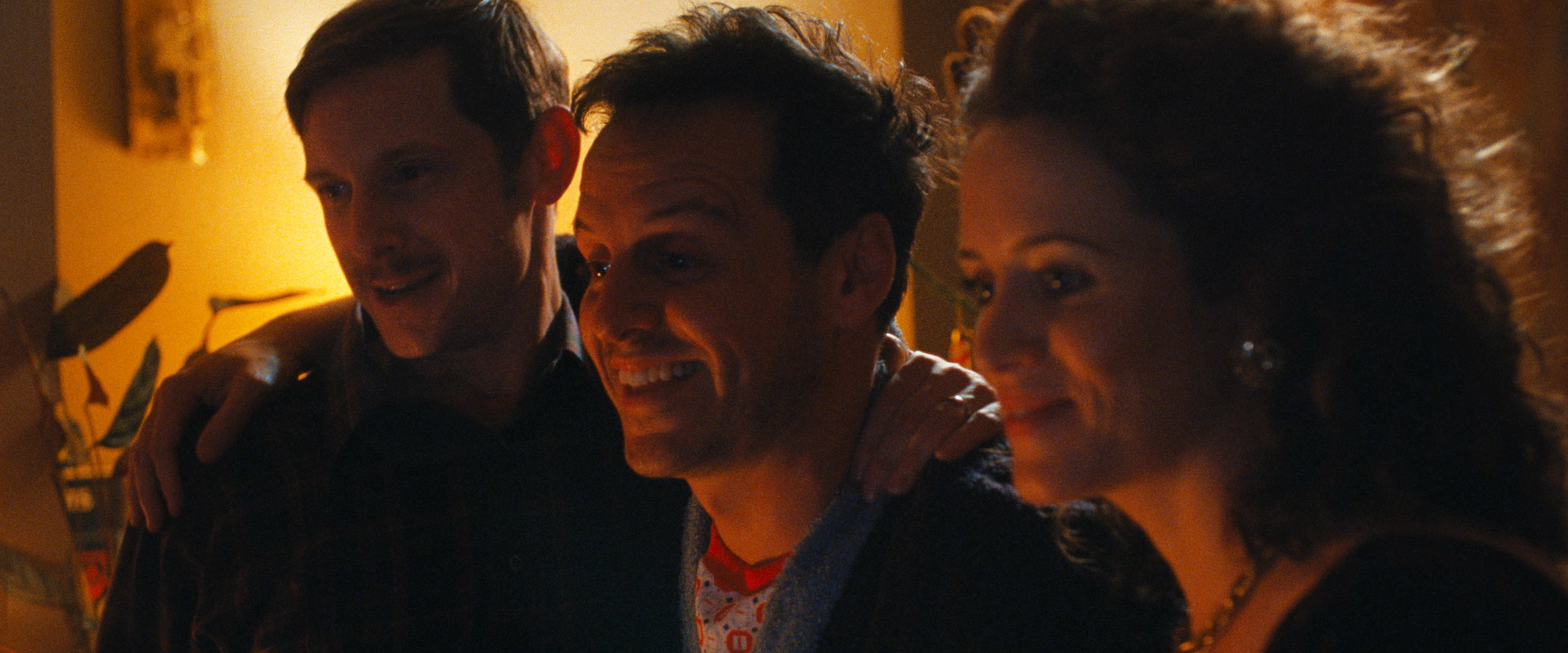

I should’ve seen Andrew Haigh’s All of Us Strangers coming when I found out it was an adaptation of the late Taichi Yamada’s Strangers. In this psychological horror novel, a television writer meets a couple who very much look like his late parents, only to find out that they are ghosts and are slowly taking away his health. And yet, where the movie begins with Adam (Andrew Scott) mustering up the courage to take the train to his parents’ (Jamie Bell & Claire Foy) house to come out as gay, the film is initially presented as a traditional queer drama examining the effects of coming out from Adam’s point of view of how he perceived his parents.
But then Haigh introduces audiences to Harry (Paul Mescal), Adam’s love interest, and this is where the film’s aesthetic and tone radically shifts into something more striking and evocative. Slowly but surely, the comfortable pace editor Jonathan Alberts establishes with cinematographer Jamie D. Ramsay begins to distort itself. Fragments of Adam’s life with his parents and dreams aren’t discernable, and his love life with Harry crumbles. The midpoint reveal hits like a punch in the gut by a thousand bricks happening all at once, and the rest of the film is a profoundly devastating study of grief and how we want to hold on to our memories to believe our parents are still here with us.

There’s a specific sequence that puts what we had previously seen (and the rest of the film) into perspective: Adam’s parents passed away from a tragic car accident when he was twelve years old, and he still hasn’t recovered from the crash. That’s why he keeps returning to his parents’ house, with his mum and dad still apparently living their lives. During Christmastime, Adam wakes up with a throbbing headache at their house and sees them fixing the tree for the holidays. The three take a photo of each other, happy to be here as a family. There’s only one problem: the family photograph is developed with the twelve-year-old Adam with his parents, not at his current age.
It’s the film’s most potent image, signaling that he has never grown past his parents’ passing and wants to relive (and create) memories with them as if he was still a twelve-year-old child instead of moving on towards a better life, with his parents’ love still in his heart. When he goes to a restaurant [alone] and orders a “family special,” with a child’s twinkle in his eyes, he still wants to believe that he is a child and that his parents are right here alongside him. He refuses to move on, no matter what Harry tells or wants to make him feel. The devastating glare in Scott’s eyes as he wants to believe his parents are still here is enough to make anyone cry, with the actor giving the best performance of his career. There’s a quiet soulfulness to how he approaches his memories with his parents, which turns more depressive as he progresses to the realization that they have moved on, and he needs to move on.

Jamie Bell in ALL OF US STRANGERS. Photo by Chris Harris. Courtesy of Searchlight Pictures. © 2023 Searchlight Pictures All Rights Reserved.
But those who ever lost a loved one know how difficult it is to move on. It’s been five years since I lost my grandfather, and while I regularly visit my mother’s family, I’ve never gotten used to the empty chair at the dinner table. Just like Adam, I frequently dream about him, remembering the insane Christmas parties and the presence he had in our family. So you can’t blame Adam when he only wants to have his parents beside him and accept him as who he is. He never had a chance to come out to his parents and say what he feels about them while reminiscing his childhood, but now he feels he has that chance with the shadows of his parents standing next to him. It’s a beautifully calibrated turn that deserves far more love than it’s getting in awards shows.
The same can be said for Mescal, who gives a much more impactful performance here than in Charlotte Wells’ Aftersun. As much as he wants to open himself up to Adam, his partner’s refusal to move on causes a massive emotional toll on their relationship, which leads to the single saddest scene of the year. Mescal seems to be a master at representing so many innate feelings he boxes in for most of the runtime, only for them to all be revealed near the end, leaving us wholly wrecked by the overflow of emotions he represents in those final scenes. But there’s a simplicity to Mescal’s portrayals that makes him such a compelling actor and why he’s so in demand right now. How he embodies sadness and despair has yet to be matched with an actor of his caliber, even though Scott imbues his sadness with a different glare than Mescal.

Foy and Bell beautifully complement these performances as Adam’s parents, whose silent expressions say more than what they say to Adam. When he comes out to his mother, the atmosphere grows colder just from how she looks at her son and says, “I suppose I never did know what was going on in that odd little head of yours.” The rest of the film sees her perceive her son in a different light, never knowing if she fully accepted him as who he is, making her performance all the more sadder when you know the full context of Yamada’s story.
In a powerful showcase for Bell, the father explains he isn’t surprised at finding out his son is queer, but it’s the realization that his son won’t be him that breaks his spirit. It’s almost as if his parents wanted to posit their son as a reflection of themselves and didn’t want to accept that he’s different and has unique sensibilities that his parents didn’t seem to grasp. This makes the film’s latter sequences all the more harrowing, knowing this is it for Adam before he has to move on, with so many unresolved feelings he’ll never get to express in front of them. It’s a lot to take in, and some may initially dismiss Haigh’s spiritual approach, especially for those who are still grappling with the loss of a family member, but it also gives people hope that their best days are still to come if they take one step at a time to process their grief.
As a result, All of Us Strangers triumphs. Its performances are quietly devastating, with Haigh’s direction slowly veering off its conventional trappings for a more aesthetically enveloping study of how our grief will never go away, no matter the fantasies we create in our dreams to make it feel as if our loved ones are still there. Like Haigh’s 45 Years, the facial expressions of its lead actors convey more than their spoken words, ultimately leaving us more wrecked than we were when the film began.
All of Us Strangers releases in select theatres on December 22.
Discover more from The DisInsider
Subscribe to get the latest posts sent to your email.
