
Is it truly over? Is the magic lost forever? I certainly don’t want to believe it is, but I’ve fully resigned myself to the fact that the Marvel Cinematic Universe, as we know and love, is gone. The excitement one, like myself, would get over the prospect of seeing the latest MCU title on opening day has been completely dissipated with a string of mediocre-to-unwatchable projects we’ve been getting on the film and television side ever since WandaVision landed on Disney+ in 2021. That doesn’t mean it’s been all bad, far from it: X-Men ’97 was a remarkable high point on Disney+, and I won’t hear any Eternals slander, just to name a few.
However, with Marvel now attempting to jingle keys in the hopes that audiences will flock back to the cinema with the upcoming Avengers: Reddit, it’s safe to say things have gone bleak. A past mandate of producing an endless stream of shoddily made films and television series just for the sake of releasing them has over-exhausted what was once a well-oiled machine that is now churning out first-rate junk that some audience members still lap up as being “solid entertainment” or “doing what it needed to do” as a defense for mediocrity. We rarely saw this happen before the arrival of Bob Chapek at the Mouse, but it has now become the norm. However, with Bob Iger back in the fold, things seem to be course-correcting themselves because this iteration of Marvel is clearly not working. But is it too late?
With Robert Downey Jr. returning to the franchise after winning an Oscar for the best performance of his career, it seems like they’re so desperate to recapture the same skyrocketing success of a nearly perfect ten-year journey. Instead of simply recasting Kang, since the Multiverse allows for simple explanations, the studio has now kowtowed to fans who don’t even read comics and only want to point and clap at the screen for a momentary dopamine rush of consuming product and getting excited for next product. As Robert De Niro once said, we’re in a terrible situation, and it doesn’t seem like it’ll get better anytime soon.
Enter Captain America: Brave New World, the 35th entry in a never-ending franchise that has expired all of its good graces. Yet, entering the IMAX 3D auditorium, I was cautiously optimistic that Julius Onah’s follow-up to The Falcon and the Winter Soldier would be a somewhat palpable political conspiracy thriller and a great first big-screen vehicle for Anthony Mackie’s Sam Wilson, after taking over the Captain America mantle from Steve Rogers. The second trailer is one of the best-edited advertisements I’ve seen in a very long time, and it genuinely got me excited for the picture, which rarely happens in my case anymore. But the promo was truly incredible, a mixture of what looked like contemporary suspense with an old-school flair in its musical and title cards. It felt like Marvel was tapping into something they previously were afraid to discuss but are now fully delving deep into its intrigue the way any good political thriller should do.
Yet, with the MCU being one of cinema’s most popular intellectual properties, rumors abound whenever a new title gets released. Reports of negative test screenings and reshoots that scrapped entire characters and scenes (notably removing Rosa Salazar and Seth Rollins from the film) to replace them with Giancarlo Esposito’s Seth Voelker certainly looked concerning. But rumors and reports are just words meant to drive engagement, no matter how true or false they may be. We’ll honestly never know if it’s bad until we’re in front of the cinema, watching the finished product. People can write what they want, but what’s on-screen matters most. The big screen never lies, and one can immediately tell if reshoots were as “disastrous” as the stories made them out to be or if internal reports of negative test screenings were true.
When Brave New World opens with news channels discussing President Thaddeus Ross’ (Harrison Ford) election, Onah and co-writers Rob Edwards, Malcolm Spellman, Dalan Musson, and Peter Glanz fall into the over-expository rut of explaining everything three or four times, hand-holding the audience to no end, as if they’re unable to put two and two together. Take, for instance, a news anchor contextualizing the President’s nonexistent relationship with his daughter, Betty (Liv Tyler), following the events of The Incredible Hulk, describing her as “Bruce Banner’s ex-girlfriend.” Or how about when Joaquin Torres (Danny Ramirez) explains to Sam that the film’s primary antagonist, Samuel Sterns (Tim Blake Nelson), has “figured out a way to plant commands into people’s subconscious using flashes of light”? Anyone instantly knows what this means, but Wilson needs to say “Mind control” right after to spell it out for the audience, ensuring they’ll never think for the film’s duration.

(L-R): Harrison Ford as President Thaddeus Ross and Anthony Mackie as Sam Wilson/Captain America in Marvel Studios’ CAPTAIN AMERICA: BRAVE NEW WORLD. Photo by Eli Adé. © 2024 MARVEL.
All of this occurs throughout the 118 minutes of a production that looks to have been reshot, rewritten, and re-edited over a hundred times in the course of two years. It feels miraculous that it even came out in this shape, as wobbly and nonsensical as it is. Onah and his credited co-screenwriters can’t even correctly set the plot in motion and would instead present a bunch of loose threads that are never resolved nor actively developed, such as the haphazard introduction of the Serpent Society by way of Esposito’s exposition-heavy Sidewinder. As cool as he looks, with a perfectly shaped trenchcoat, a machine gun, and sunglasses, the dialogues he’s given are so terrible one thinks we’re watching a Sony Marvel movie rather than something out of the MCU. Barring one frightening extreme close-up of Voelker’s face after an attempt on Cap’s life, the character seems only like an anchor for overexplaining details that the audience might’ve missed when they were already drawn out to us two scenes ago through different variations.
The bulk of Brave New World involves a political conspiracy surrounding Ross after a mind-controlled Isiah Bradley (played by Carl Lumbly, the film’s only saving grace) attempts to assassinate him. Wilson and Torres investigate who the real perpetrator is without the President’s approval, while Secret Service agent Ruth Bat-Seraph (Shira Haas) also conducts her inquiry at Thaddeus’s request. They all eventually discover that Sterns is behind it all and has motivations so paper-thin they make less sense the more you think about it. Discussing these in detail would mean spoiling some plot machinations, but you’d be completely lost even if I lay it all out here.
Tim Blake Nelson is a fine actor, but he has nothing to work with beyond the garish makeup work they have him caked in. As much as eyes rolled when Marvel announced his return, The Leader is genuinely one of the most terrifying antagonists in Hulk history, a true agent of fear and paranoia just in how his powers are so strong that not even the Big Guy himself could resist being mind controlled. To see him turn into a complete joke in Brave New World adds insult to injury. He could’ve been a tangible, frightening chaos agent that eventually led the United States into an unprovoked geopolitical conflict with Japan over adamantium resources following the emergence of Tiamut on Earth. However, Onah never actively engages with the villain or with the politics of his movie, and any attempt at making a paranoia thriller falls embarrassingly flat.
Many will argue that Marvel movies aren’t political or shouldn’t be. That’s hilarious, in and of itself, because any film that promotes the military-industrial complex is inherently political, but we’ll let that slide for one second. Let’s look at what the movie offers. When the historically anti-establishment (and anti-government, if we look at Steve Rogers in the MCU – he didn’t want to sign the Sokovia Accords, may I remind you all) Captain America is suddenly forced to work hand-in-hand with the President, who previously locked him up in The Raft in Captain America: Civil War, what do you think will happen? Ideologies undoubtedly clash, and the movie automatically becomes political, especially when it involves Japan and its Prime Minister (played by Takehiro Hira, who also portrayed him in Guy Maddin, Evan Johnson, and Galen Johnson’s Rumours, a vastly superior movie that has an actual backbone) in a war over a critical resource.
Wilson, was previously positioned as a centrist in The Falcon and the Winter Soldier who was open to working with the government when Steve Rogers shunned them. There were implications that Spellman barely explored in that show, as a Black man who has now become the mouthpiece of an entity that has imprisoned and used another super-soldier as a prop for their experiments. Still, many forgave him for his missteps since they were seemingly introduced to be likely further developed in future installments. In this film, he’s forced to work with a conservative, jingoistic warmonger who suddenly grew a conscience after becoming President and wants to unite all Americans to work “together!” That’s fine and all, but the most interesting aspect of such a movie is finding out what happens when both go toe-to-toe. Sam now has his allegiances and ideologies tested when the President’s hidden agenda is exposed. Well, not really.

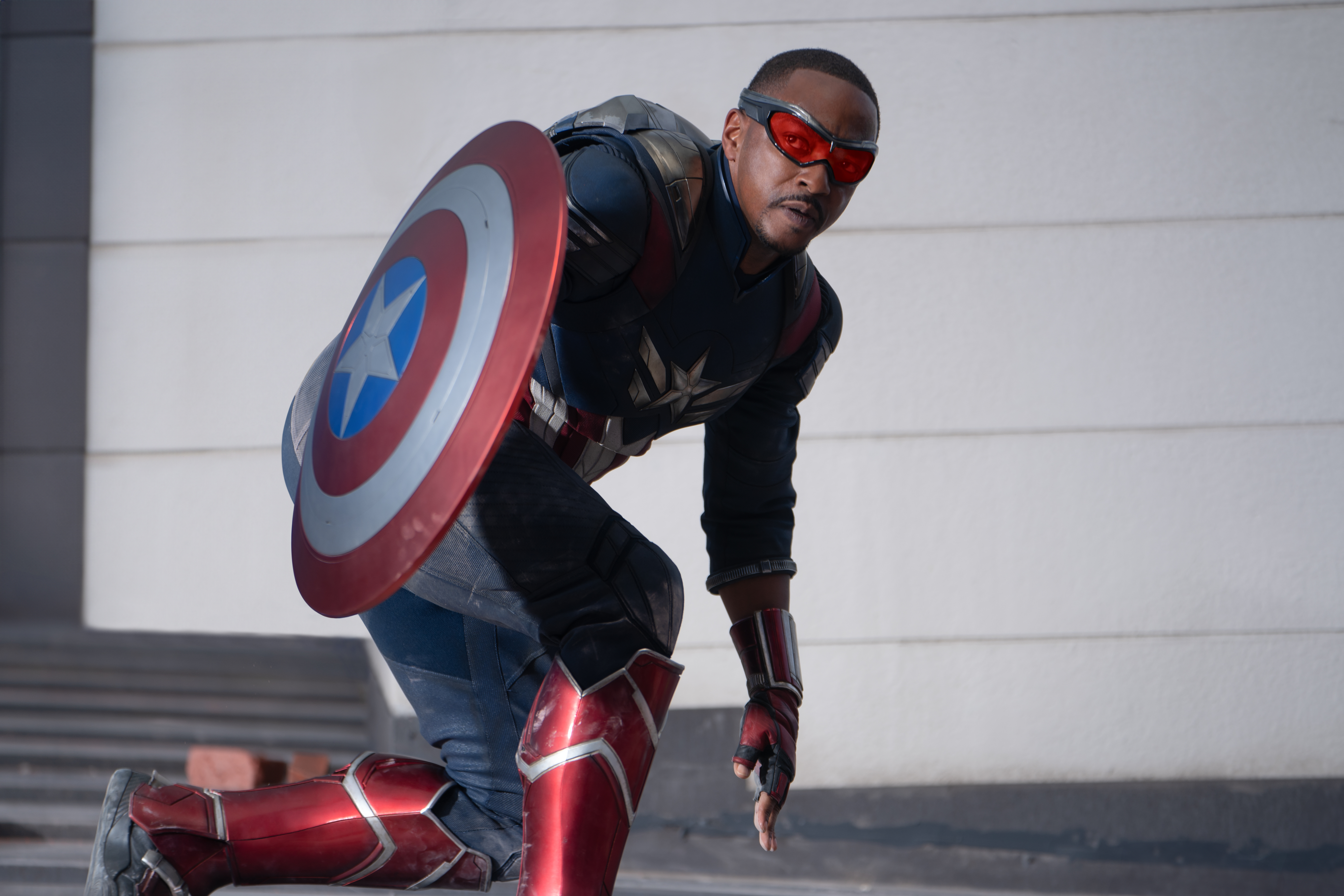
Anthony Mackie as Sam Wilson/Captain America in Marvel Studios’ CAPTAIN AMERICA: BRAVE NEW WORLD. Photo courtesy of Marvel Studios. © 2024 MARVEL.
Oh, sure, there’s a scene where the two go face-to-face, and Ross tells him to back off because he’s “not Steve Rogers” and “This is politics. So you better wise up, son.” Yet, there isn’t a moment where Onah is willing to say something about the film’s political backdrop, whether on the growing conflict over adamantium, the paranoia with The Leader suddenly controlling minds inside The White House, in the FBI and the U.S. Army, or in where Wilson’s ideologies now lie. It treads in incredibly muddy waters and tries to say the “right” things to not offend audience who wants to see a Marvel movie featuring the President turning into a Red Hulk. A Red Hulk who ends up destroying The White House, an image devoid of all of its significance when Onah is too afraid to grow a spine and engage with what this conflict presents for the United States, and the character of Sam Wilson.
This spinelessness goes as far as cutting any backstory involved with Shira Haas’ Ruth, an Israeli former Black Widow who’s now become the President’s personal security detail. The character, a “modern reinterpretation” of one of Marvel’s most controversial, Sabra, has had her background and any connection with the comic books wholly stripped, likely due to what is currently ongoing in the Middle East. So why was it necessary to bring her specifically into this film when she’s now become a mindless Black Widow with no singular personality and zero chemistry with Wilson or Torres? It doesn’t help that she gives a profoundly stilted performance, leading us to wonder why they ever considered such a character in the first place, especially regarding the backlash Sabra has been getting ever since its inception in the comics. Yet, she’s not the worst side protagonist to have gotten Frankensteined. That award goes to Xosha Roquemore, who appears as Sam’s point of contact in the Secret Service in a few scenes, with zero agency or lived-in humanity that will help the audience connect to her on a profoundly personal – and emotional – level.
The only dynamic that feels somewhat complete in Brave New World is Sam’s relationship with Isiah Bradley, only due to Carl Lumbly’s profoundly moving and vulnerable performance. When he tells Cap, “I can’t go back inside, Sam!,” we feel for his plight, knowing what this will likely mean for him. But like with any other movie hacked to bits, we rarely get scenes that last longer than two minutes with him, and his emotional arc feels gimped instead of the beating heart and soul of Sam’s quest to find the real perpetrator behind it all.
All of the characters in Brave New World have zero chance to grow beyond the tired “middle-ground” discourse that Wilson has been stuck in ever since his introduction in Captain America: The Winter Soldier. You’d think his beliefs would change after taking over the shield from Steve Rogers, but the needle has barely moved after a full series and now a feature film. He’s still the same Captain America who embraces the status quo, rarely questions authority, and would rather cozy up to the political system than shake it and give America a true symbol of hope after corrupt entities sought to break it for the past decade within the continuity of the MCU.
It feels especially weird to see a political thriller never actively offering the audience a sizeable text to engage in, but I shouldn’t be at all surprised. Disney has never been the one to grow a spine – they’d rather bend themselves to Donald J. Trump’s anti-DEI demands than actively confront it, so why should they give something to think about for their audience with Captain America? Add a glut of poorly shot and edited action sequences, a bored, phoned-in Harrison Ford, and a screenplay that sadly betrays the sincerity Mackie gives to his turn as Sam Wilson, and it’s easy to tell why the MCU is in complete shambles.
When Captain America: Brave New World eventually reaches a show-stopping, IMAX-shot battle on Tiamut Island, the visuals seem to belong in a completely different movie than the over-edited nightmare of its earlier action setpieces. The aerial point-of-view shots that follow both Cap and Falcon are dizzyingly kinetic and leap off the screen. Yet, since we seldom have a clue what’s going on and have very little time to latch onto the characters emotionally, we quickly do not care that the synthetic images look good and have impressive depth-of-field in IMAX 3D. They simply become sludgy distractions that eventually leads to what we’ve all been waiting to see: Harrison Ford as Red Hulk.
When that happens, and Onah fills this confrontation with potent symbolism that immediately recalls what’s currently occurring in America, it arrives far too little too late for his film to result in anything meaningful, whether artistically or thematically. In 2025, to make a movie on a Black Captain America at odds with a Republican, war-hungry President hellbent on diverting army resources to develop technologies with an unstable material from another world and not saying a damn thing about politics, war, or how the act of being a symbol for America while the country is still recovering from intense division may internally divide the person wearing the red, white and blue, could be the single biggest act of cowardice I’ve seen since corporations have begun to acquiesce with Trump’s demands instead of pushing them back.
If you’re not willing to say something, then what are you doing?
Captain America: Brave New World is now playing in theatres.
Discover more from The DisInsider
Subscribe to get the latest posts sent to your email.


