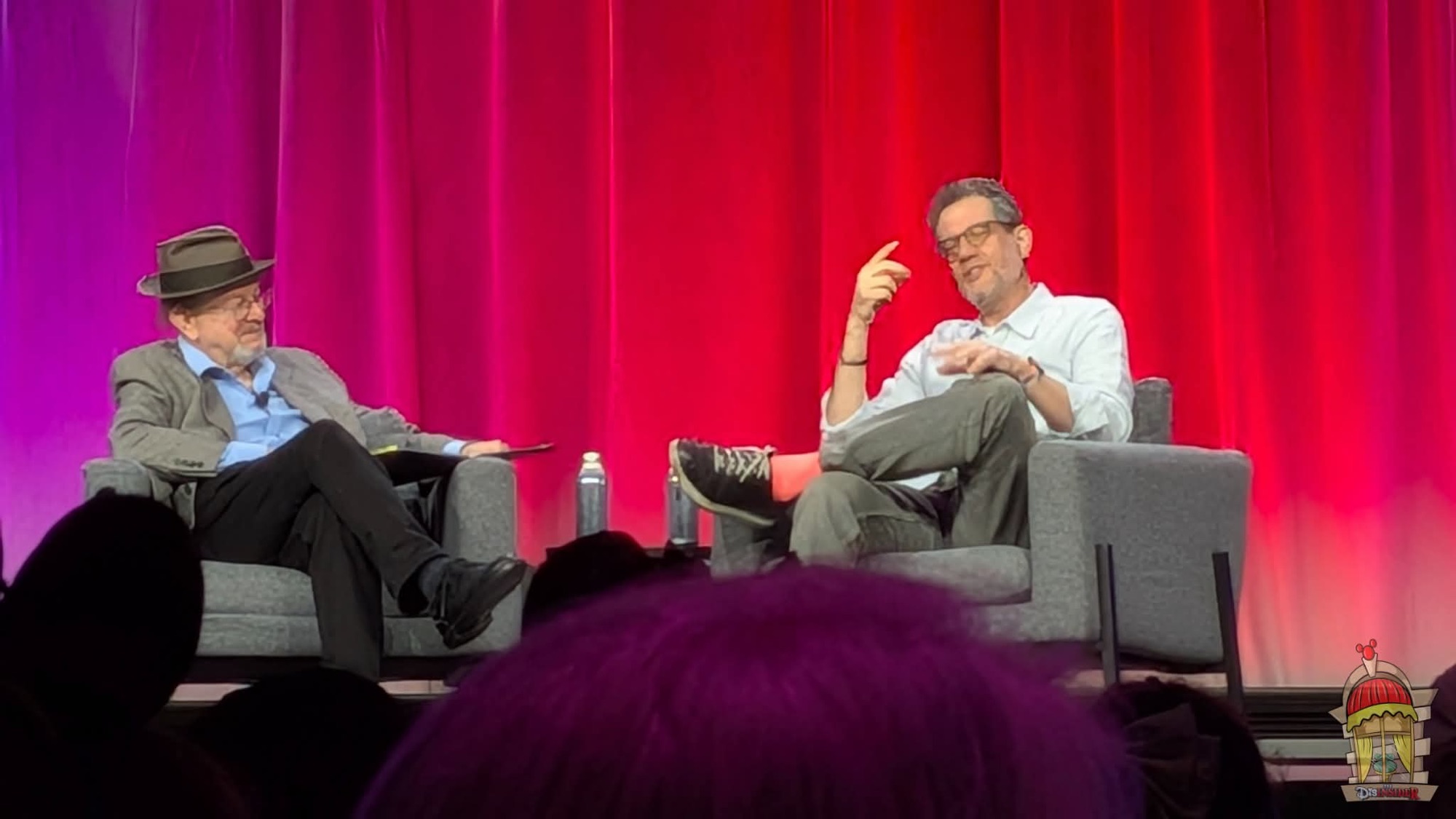

During the D23 Fan Event, we had the incredible opportunity to see Academy Award-winning composer Michael Giacchino take the stage for the “Art of the Score” panel. Giacchino has created the music behind some of the most memorable moments in movies and television, and during the panel, he shared stories from his career across Disney, Pixar, Marvel and Star Wars.
Following a montage featuring clips from Giacchino’s work in movies, television and video games, journalist and film music historian Jon Burlingame joined him onstage for a conversation about his journey into Hollywood.
Giacchino’s career with Disney began in publicity. He studied filmmaking at the School of Visual Arts before continuing his education at Juilliard and UCLA, focusing on music and orchestration.
One of his earliest opportunities came when he offered to write a jingle for a project. He was paid $2,000 and immediately used the money to purchase music equipment.
From there, Giacchino began working on video games, including Disney’s Gargoyles and Maui Mallard in Cold Shadow. While also doing animation work for DreamWorks and The Lost World: Jurassic Park video game, he was asked to write music for the game.
Giacchino admitted he “didn’t think anything of it” at the time, but the opportunity eventually led to him composing the entire score. His work later caught the attention of J.J. Abrams, opening the door for Giacchino to score Alias and Lost.
Giacchino described the music of Lost as “the most me” of anything he has created.
Rather than reading the scripts ahead of time, he chose to watch each completed episode without allowing the script to influence his initial reaction. The music arrived one episode at a time, with each score recorded using a full orchestra.
Giacchino also recalled his first meeting with The Incredibles director Brad Bird. After returning home, he wrote “The 100 Mile Dash” as a demo for the film.
He explained that Bird understood the importance of a director and composer being in lockstep. The music and visuals had to work together to tell the same story.
Fans were then treated to footage of the orchestra performing music from The Incredibles.
For Ratatouille, Giacchino compared the creative process to arriving home from work and making dinner with whatever ingredients happen to be available.
“You just got home from work and you’re making dinner with what you have at home,” he explained. “A little of this and a little of that. That’s how we approached this score.”
Giacchino also reflected on Up, which earned him the Academy Award for Best Original Score. He jokingly thanked legendary composer John Williams for saying no to the project and giving him the opportunity to take it on.

While working with director Pete Docter, Giacchino found inspiration in an album from The Muppets. The panel also featured behind-the-scenes footage from one of the film’s recording sessions.
When asked whether he approaches animated and live-action movies differently, Giacchino said his process is essentially the same.
Every movie must be looked at individually, with something created specifically for that story. He compared composing a score to the work of his grandfather, who was a tailor. Just as a tailor creates a suit to fit one person, Giacchino creates a score that fits one movie.
For Inside Out, Giacchino drew inspiration from his daughter, Gracie, as well as Pete Docter’s daughter, Elie.
Both girls were young when the film was being developed, and their fathers found themselves thinking about how their daughters processed their emotions internally. In that sense, Inside Out became a love letter to them.
The audience watched footage of the percussion section recording the music accompanying Riley’s first day at her new school.
Giacchino also revealed that the musicians generally do not see the score before arriving at the recording session. They receive the music that day and are often performing it for the first time while it is being recorded.
Authenticity was essential when Giacchino began working on Coco. He collaborated with the Mexican Institute of Sound while developing the film’s musical identity and spoke fondly about his experience working with director Lee Unkrich.
The panel included another behind-the-scenes clip showing the orchestra recording music for the film.
Giacchino later discussed his work on Zootopia and Zootopia 2. While he previously composed music for Disney’s Prep & Landing television specials, the Zootopia films marked his work on Walt Disney Animation Studios theatrical features.

The conversation also turned to Tomorrowland, including the backstory behind Giacchino’s cameo appearance in the film.
The project gave him the chance to work alongside Disney Legend Richard Sherman, whom Giacchino described as one of the “most kind and fun” people he had ever met.
Fans were shown footage of Giacchino and Sherman working together and listening to “There’s a Great Big Beautiful Tomorrow,” which was incorporated into the movie.
While discussing Rogue One: A Star Wars Story, Giacchino addressed the pressure that came with following the musical legacy of John Williams.
For Giacchino, the story had to come first and nostalgia had to come second. Williams’ music was perfect for the moments it originally accompanied, but Rogue One needed its own musical identity.
Giacchino approached the movie from the perspective of his 10-year-old self, remembering what it felt like to listen to the original Star Wars album over and over again. He wanted to recapture the feeling that music gave him as a child.
Giacchino also revealed that one of the biggest regrets of his career involved the Marvel Cinematic Universe.
He had previously been asked to score Captain America and The Avengers, but scheduling conflicts prevented him from accepting either project.
When Marvel later approached him about Doctor Strange, he immediately said yes.
The opportunity carried special meaning for Giacchino, who recalled visiting a New Jersey flea market with his mother to buy Marvel comic books as a child. His relationship with Marvel continued when he composed the music for the studio’s updated logo and later entered the world of Spider-Man.
For The Fantastic Four: First Steps, Giacchino wanted the music to capture the collaborative and optimistic world represented by Marvel’s First Family, a world he hopes our own can become.
He jokingly described the sound as a mashup between Disney’s Main Street Electrical Parade and The Right Stuff.
The score was recorded at Abbey Road Studios with a 100-person choir and a 101-piece orchestra. Footage shown during the panel featured the choir performing the music on sight and recording it during its first look at the material.
Unlike most films, where the score is developed much later in production, Giacchino wrote the main theme early enough for it to be unveiled at San Diego Comic-Con while the movie was still being made.
Giacchino also discussed making his directorial debut with Marvel Studios’ Werewolf by Night.
When Kevin Feige told him Disney+ was coming and Marvel wanted to create a variety of projects for the streaming service, he asked Giacchino what he would make if given the opportunity to do anything.
Giacchino immediately answered, Werewolf by Night.
The project allowed Giacchino to bring his storytelling instincts from the recording stage to the director’s chair.
Having now scored four Spider-Man movies, Giacchino said Peter Parker remains a character audiences can immediately understand. We have watched him grow up, make mistakes and repeatedly find himself in situations far beyond his control.
For Spider-Man: Brand New Day, Giacchino initially attempted to write an entirely new theme, but it did not feel right.
Instead, he returned to his original Spider-Man theme and began taking pieces away. Notes and layers were removed, musically reflecting how Peter’s friends have been taken out of his life.
As the movie progresses, those missing pieces are gradually added back into the score.
The “Art of the Score” panel offered a fascinating look at Giacchino’s creative process and the personal stories behind some of his most recognizable music. Whether he is working with superheroes, toys, emotions, animals or characters in a galaxy far, far away, Giacchino continues to create music that feels inseparable from the stories being told onscreen.
Discover more from The DisInsider
Subscribe to get the latest posts sent to your email.
