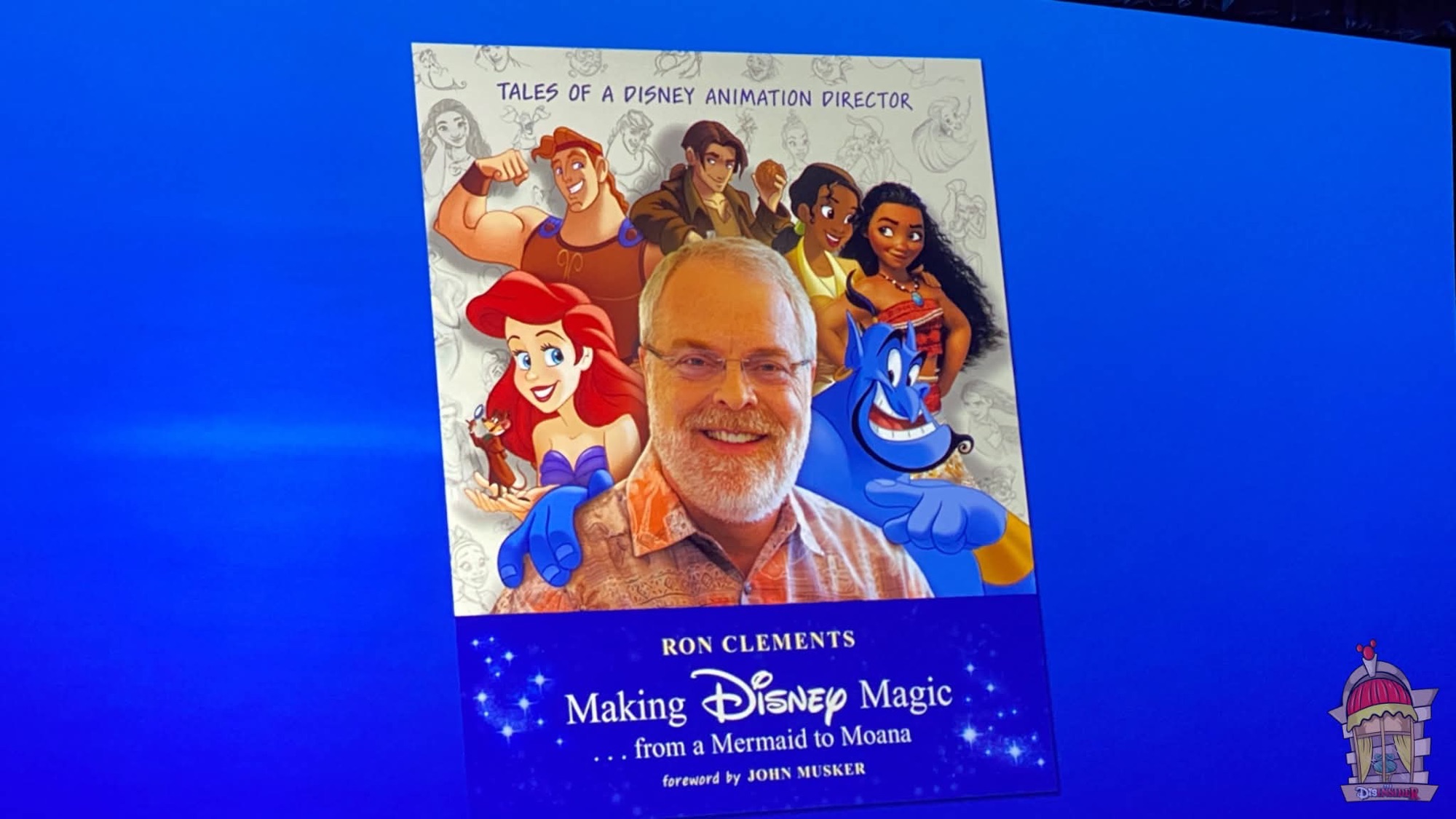

During D23: The Ultimate Disney Fan Event, we had the incredible opportunity to attend “Making Disney Magic with Ron Clements,” a celebration of one of the most influential filmmakers in Disney Animation history.
Hosted by film critic and historian Leonard Maltin, the panel took fans through Ron’s, remarkable career, from his earliest days as an aspiring animator to the creation of beloved films including The Little Mermaid, Aladdin, Hercules, Treasure Planet, The Princess and the Frog and Moana.,

Leonard began the conversation with Ron before welcoming several special guests who helped bring those unforgettable stories and characters to life.
Ron traced his love of animation back to seeing Pinocchio. The film had such a profound effect on him that it inspired him to begin creating animation of his own.
His career started with a brief three-month stint in Hanna-Barbera’s trainee department before he joined Walt Disney Animation Studios in 1974. Once at Disney, Ron had the opportunity to work alongside several of Walt Disney’s legendary Nine Old Men and learn directly from the artists who helped establish the studio’s animation legacy.
A major part of Ron’s career was his creative partnership with John Musker. Ron explained that the two shared similar feelings about the types of movies they wanted to make. They also had different strengths and weaknesses, allowing them to complement each other throughout their years working together.
Ron’s connection to The Great Mouse Detective went all the way back to his childhood in Iowa, where he created an original 15-minute animated story inspired by Sherlock Holmes.
That early fascination made the opportunity to work on Disney’s mouse-sized mystery especially exciting. Ron helped direct the film and develop its storyboards during a time when the project did not have a traditional completed screenplay. Instead, much of the story was developed visually through the storyboard process.
The film became an important turning point for Disney Animation and helped set the stage for the era that would follow.
The conversation then moved to The Little Mermaid, which Ron and John pitched during a meeting that operated like Disney’s own version of The Gong Show. Filmmakers presented their ideas to Jeffrey Katzenberg and Michael Eisner, hoping their concepts would survive the room..

Jodi Benson joined the panel and shared the unlikely story of how she became the voice of Ariel.
Jodi had been appearing in the Broadway musical Smile, which closed after a short run. Feeling bad for the cast, Howard Ashman invited several of the performers to audition for an upcoming Disney animated film.
Jodi joked that she auditioned for Ariel “on my way to the unemployment line.”
That audition changed her life. Jodi is now celebrating 40 years of working with Disney and continues to return to the recording studio as Ariel, keeping the character’s voice and spirit alive for new generations.
Eric Goldberg joined the panel to discuss Aladdin and the creation of one of Disney’s most unforgettable characters, the Genie.
The role was written with Robin Williams in mind, even though there was no guarantee that Robin would agree to play the character. At the time, Eric had his own animation company in London called Pizazz Pictures, where he worked primarily on commercials.

To demonstrate what the character could become, Eric created animation pencil tests using audio from Robin’s comedy album Reality… What a Concept. The tests were shown to Robin, who loved what he saw and ultimately accepted the role.
Eric also revealed that the guiding inspiration behind the Genie’s visual design was the work of legendary caricaturist Al Hirschfeld. His flowing lines became a major influence on the Genie’s constantly moving and transforming appearance.
Susan Egan joined Ron to revisit Hercules and her transition from playing Belle on Broadway to voicing Megara.
Susan explained that although Belle and Meg may initially appear to be completely different characters, she sees Meg’s journey as having more in common with another character from Beauty and the Beast.
“I find Meg’s story to be more in line with the Beast than with Belle,” Susan said.
Meg had been hurt, betrayed and emotionally closed off from the world. Like the Beast, she needed to rediscover trust and allow herself to love again. Susan’s personality and performance became such an important part of the character that, in many ways, Meg is Susan.
Producer Roy Conli joined the discussion for a look back at Treasure Planet, one of the most ambitious films of Ron’s career.
Ron had always loved Treasure Island and believed its timeless story could be reimagined as an adventure set in space. The filmmakers combined traditional hand-drawn animation with computer-generated imagery, giving the film a distinct visual style with an oil-painted quality.
The movie was created during a difficult period for traditional animation. Many of the artists working on Treasure Planet understood that hand-drawn animation was being phased out and that they could be without jobs once the movie was completed.
Despite that uncertainty, the artists poured everything they had into the film.
Looking back, Ron acknowledged that it may not have been the right time for Treasure Planet to arrive. The movie has since found a passionate audience and is now viewed by many Disney fans as one of the studio’s most underrated animated films..

The panel’s celebration of The Princess and the Frog brought out Mark Henn, Jim Cummings and Anika Noni Rose.
Jim, who voiced Ray the firefly, revealed that he had worked as a deckhand on a boat in New Orleans when he was younger. That experience meant he already had a strong familiarity with the local accent that became such an important part of Ray’s personality.
The character was inspired in part by a New Orleans frog-hunting tour guide, helping create Ray’s unmistakable voice, charm and infectious love for Evangeline.
Mark discussed the challenge of animating Tiana in both her human and frog forms. When asked whether animators can become typecast based on the characters they have previously animated, Mark admitted that it sometimes happens. That familiarity can occasionally be helpful, but it can also create limitations for artists who want to explore something creatively different.
Ron and John wanted to create a distinctly American fairy tale. The history, food and jazz culture of New Orleans gave them the perfect setting.
For Anika, becoming Tiana was “bigger than the biggest dream come true,” and she believes the character continues to become even more meaningful and relevant with time.
Anika was only the second person to audition for the role. As she walked through the building, she saw original animation cels from the movies that had shaped her childhood.
“When I read the script, I felt it in my bones that this was written for me,” Anika recalled.
She had just two requests for the character.
“I asked that she be left-handed, and she needs to have a little booty.” r

Both requests made it into the finished film.
Auliʻi Cravalho closed out the celebration by discussing her life-changing experience as the voice of Moana.
Auliʻi was the final actress to audition for the role. The filmmakers had struggled to find someone who could sing, act, match the character’s age and authentically represent the Pacific Islands.
She was only a teenager when she landed the part and then faced the challenge of keeping the news secret for an extended period. While Auliʻi’s voice and personality became inseparable from Moana, the character’s visual design had already been completed before she was cast.
From a young boy inspired by Pinocchio to the filmmaker behind some of Disney Animation’s most treasured stories, Ron’s career has touched generations of fans and artists.
“Making Disney Magic with Ron Clements” was more than a retrospective. It was a celebration of the artists, actors and filmmakers who gave everything they had to create stories and characters that continue to live on for generations.
Discover more from The DisInsider
Subscribe to get the latest posts sent to your email.
