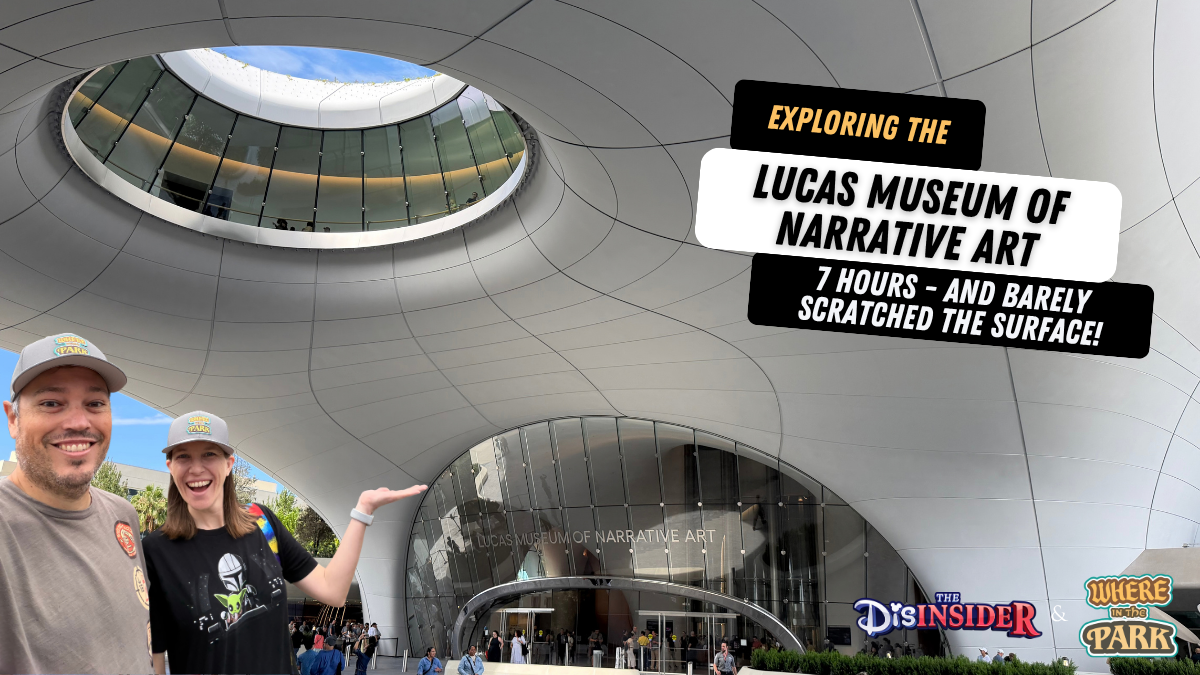

When you hear the name Lucas Museum of Narrative Art, there’s a pretty good chance your mind immediately goes to Star Wars.
We knew going in that George Lucas and Mellody Hobson’s museum encompassed far more than a galaxy far, far away. But there was also no question that Star Wars was one of the things we — and many of the guests around us — were particularly excited to see.
So when our reservation began at 2 p.m., we knew exactly where we were headed first.
Seven hours later, we left realizing just how much more there was to discover.
So, What Exactly Is Narrative Art?

One of the things that makes the Lucas Museum difficult to describe is also what makes it fascinating to explore: “narrative art” encompasses an enormous range of work.
Throughout the museum, stories are told through paintings, illustrations, comics, sculpture, filmmaking, costumes, production design, and more. One gallery might place you in front of a work by Norman Rockwell; another surrounds you with the imagery of Star Wars. Elsewhere, you might encounter original drawings of Gertie the Dinosaur, contemporary works by Banksy, or a life-size bronze Indiana Jones.
The medium may change dramatically from room to room, but the underlying idea remains the same:
Images tell stories.
And once we began looking at the museum through that lens, seemingly unrelated pieces started to feel surprisingly connected.
Building a Galaxy Far, Far Away
Our first major destination was the Star Wars section of the Cinema Gallery — and for Lucasfilm fans, there is an extraordinary amount to take in.
What makes the collection particularly interesting isn’t simply the opportunity to stand near recognizable costumes, droids, and vehicles. Yes, they make for fun photo-ops, but these displays actually allow visitors to see how the galaxy was constructed across numerous artistic disciplines.

Replicas of production artwork by Doug Chiang provided glimpses into the development of The Phantom Menace, including concepts for the film’s victory parade on Naboo, transportation on Coruscant, and the Gungan battle.
For those of you who aren’t familiar, Doug Chiang is the Senior Vice President and Executive Design Director at Lucasfilm, who started at Industrial Light & Magic (ILM) as a Creative Director in 1991. While his artwork is featured worldwide, this was our first time seeing original sculptures and large prints of his paintings in person.

Nearby, we encountered costumes by Trisha Biggar for Darth Maul and Darth Vader, along with costumes for a Tusken Raider family; Luke Skywalker’s landspeeder from A New Hope; General Grievous’ wheel bike; Sebulba’s podracer; a collapsed pit droid; and a model depicting a Gungan riding a kaadu.

Being able to move between production artwork, costume designs, models, creatures, and vehicles helps put into perspective just how many artists are required to create a cinematic world.
And what’s astonishing is that Star Wars represents only a small portion of what we encountered. Before these worlds could become part of our collective imagination, artists first had to determine how to show us what they looked like. In that sense, Star Wars becomes another example of the museum’s larger premise: images tell stories.
From Star Wars to a Very Familiar Dinosaur

Directly across the hall from the Cinema Gallery, we entered the Comics section and encountered another familiar face: Winsor McCay’s Gertie the Dinosaur, represented through original ink drawings from 1914.
Disney Parks fans may recognize Gertie for another reason. A much, much larger version still overlooks Echo Lake at Disney’s Hollywood Studios, paying tribute to McCay’s pioneering animated character.
Within a matter of steps, we’d gone from the elaborate production process behind Star Wars to deceptively simple drawings from the early history of character animation.
Kevin immediately stopped, amazed not only to find the three drawings side-by-side, but to see them displayed among artists representing completely different styles and decades of comics and animation.
That kind of unexpected juxtaposition happens constantly throughout the Lucas Museum. It not only kept us on our toes, but also created a fun seek-&-find game to see if we could spot any other works by the same artists elsewhere in the museum.
The Art That Stopped Us

Some of the works that stayed with us most had nothing to do with filmmaking.
Two displays featuring Norman Rockwell particularly caught our attention.
Rockwell’s study for First Trip to the Beauty Shop was displayed alongside the finished 1972 piece. We had no idea that the study was actually much larger and added to the overall idea and storytelling behind this iconic piece. In the study, you see the full scene of the hairdresser behind the chair – both as a person and as a reflection in the mirror. The girl getting her hair cut actually has a piece of paper with an image of a model in her hand, from which she gathers inspiration for her new look. Her mom is also more visible on the left, with a different hairdo than the final piece. It’s details like this that had us stopped here for quite some time.
We had a similar experience in Rockwell’s study for The Runaway, which appeared beside the finished 1958 work.

Seeing the studies and finished pieces together allows you to do something particularly appropriate in a museum devoted to narrative art: examine how the story changed on its way to the final image. How many details can you notice that changed between the study and the final piece?
After taking a close look, we then looked to the piece to the right of The Runaway. There hung Richard Williams’ The Militarization of the Police Department – Deadly Force, created in 2014–15.

Williams takes Rockwell’s recognizable diner composition and transforms it. The counter, stools, employee, police officer, and child remain recognizable elements, but the relationship between those figures — and therefore the story being told — has dramatically changed.
That juxtaposition stopped me.
Given ongoing conversations surrounding policing and the use of force in America, Williams’ interpretation spoke to me personally. Learning that Williams created the work in 2014–15 made the experience of encountering it today particularly striking for me. Standing there with the two works so close together demonstrated something remarkably simple about narrative art:
Change the details, and you can change the entire story.

Rockwell’s influence appeared in another form nearby.
Greg Polutanovich’s 2025–26 bronze sculpture inspired by Rockwell’s Triple Self-Portrait takes the familiar image into three dimensions. Instead of viewing Rockwell, his canvas, and his reflected image from one fixed perspective, visitors can physically move around the sculpture and examine the scene from entirely new angles.
Within these few works alone, we encountered a study becoming a finished painting, one artist reinterpreting another artist’s composition, and a two-dimensional image transformed into sculpture.
Different artists. Different media. Different messages.
All telling stories.
From Banksy to Indiana Jones

The collection stretches well beyond traditional illustration.
Several works by Banksy demonstrate just how little imagery can sometimes be required to suggest a much larger story: children beneath a “NO BALL GAMES” sign, a girl reaching toward a heart-shaped balloon, or a figure working against an elaborate pink pattern.
What was fascinating about Banksy’s work is that it wasn’t labeled anywhere on the map. The lions pictured above were actually at the end of the “Children’s Stories” exhibit. After seeing that it was a Banksy, we were stunned and initially thought it was the only Banksy in the museum. We then learned that there was an exhibit on the fifth floor called “Murals” – and it was here that we found the other Banksys pictured (and several others we have intentionally left out of this article for you to experience for yourself).

Then there were many discoveries that appealed directly to our love of looking for the details.
Lawrence Noble’s 2025 bronze sculpture of Indiana Jones naturally caught our attention — and then we looked down.
Worked into the base near Indy’s feet was the artist’s mark: “L. Alan Noble — Noble Studio — Crestline, Calif.”
It’s a tiny detail that would be easy to walk right past.
Naturally, we loved it – and you know we had to take a photo!
The Moment We Realized We’d Missed… A Lot
There was one problem with taking our time exploring all of this:
The museum is enormous!
After several hours in the galleries, we stopped at the café to eat dinner before eventually heading to the gift shop.
That’s where our leisurely museum visit abruptly became a race against the clock.
We picked up one of the books featuring the collection on display and started flipping through it. We immediately said, “Wait. Did we see that?“… “Where was that one!?” … “Did we even see this museum?!”
As we continued through the book, we realized there were entire portions of the galleries we had somehow missed.
And we had only about two hours left before closing.
Suddenly, we had a mission.
Instead of leisurely wandering, we began identifying specific pieces in the book that we hadn’t seen and heading back through the galleries trying to find them.
If anything demonstrated the scale of the Lucas Museum better than a unit of measurement ever could, it was that moment.
We had already been there for hours.
And we’d missed that much.
There Is More Than Art on the Walls
Our exploration wasn’t limited to the traditional galleries.
There are two theaters on the first floor: the Slavko Vorkapich Theater and the Robert Flaherty Theater. Programs run continuously throughout the day, ranging from short films exploring the language of cinema itself — editing, light, motion, color and sound — to Star Wars Detours, an unaired animated comedy series that parodied the Star Wars films.
Because visitors can enter and leave throughout the program, the theater feels almost like another gallery, except here the images move.

The Research Library was one of our final stops. Here, visitors can peruse the wide variety of books, comics, and more on the first floor. For anything on the second and third floor, you must ask for a librarian to retrieve it for you. To browse the full library catalog, visit the museum’s library page here.
Regardless of the shelf, the books must stay in the library itself – this is a non-circulating library, which means you cannot check them out. There are a number of seating areas around the room to read the books, complete with USB charging stations, ample lighting, and a panoramic view of the grounds outside.
The beautiful multi-level room immediately felt like somewhere we could spend considerably more time, but by then the clock was very much working against us.
That became a recurring theme toward the end of the night.
There was always one more thing we wanted to see.
Seven Hours Wasn’t Enough

We arrived at 2 p.m. already knowing we weren’t walking into a “Star Wars museum.”
We still weren’t prepared for just how expansive the Lucas Museum of Narrative Art would feel.
Over roughly seven hours, we encountered cinema, comics, illustration, paintings, sculpture, concept art, animation, costumes, vehicles, and experimental film. We found works we’d been excited to see and others we hadn’t known existed that became some of the most memorable pieces of the day.
We ate.
We went shopping.
We discovered a book and realized we’d somehow missed entire areas.
We raced back upstairs to find what we had missed.
We returned to Star Wars for one last look.
And we still didn’t see everything.
Maybe that’s the best endorsement we can give it.
If Star Wars is what gets you through the door, absolutely come for Star Wars.
Just don’t expect it to be the only thing you remember when you leave.
And for us, thankfully, this isn’t the end.
We’ll be returning in just a couple of weeks, when we have reservations for dinner at Skywalker Grill, located on the top floor of the museum. After our first experience, we’re already looking forward to spending more time with some of the things we rushed through — and finding out what else we somehow managed to miss.
One thing is certain: we’ll be consulting our book from the gift shop before we start exploring next time!
Share Your Experience With Us!
Now we want to hear from you!
Have you explored the Lucas Museum of Narrative Art? What pieces stood out to you? What areas do you want to spend more time in?
Comment below, or reach out to us at TheDisinsider on your favorite social media platform.
Discover the Lucas Museum
The Lucas Museum of Narrative Art is located in Los Angeles’ Exposition Park.
Plan Your Visit & Purchase Tickets
Learn more about the Lucas Museum of Narrative Art
Discover more from The DisInsider
Subscribe to get the latest posts sent to your email.
