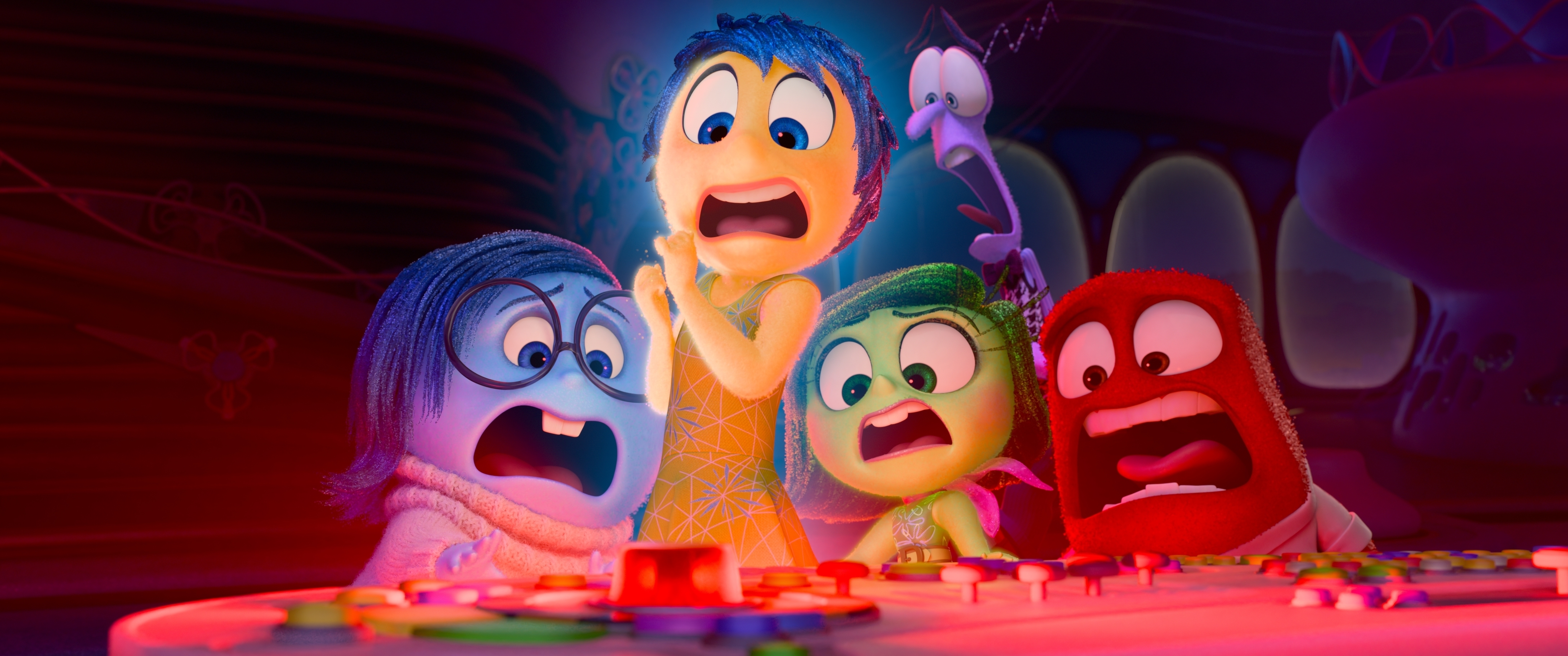

There’s a scene in the original Inside Out, where Joy, Sadness and Bing Bong are riding a train through Riley’s mind to get back to headquarters. While on the train, Bing Bong tells the two emotions that you can see everything inside Riley’s mind from how high they are. “There’s inductive reasoning,” he says. “There’s déjà vu. There’s language processing. There’s déjà vu. There’s critical thinking. There’s déjà vu…” It’s one of the original film’s funniest moments. However, it’s also how audiences might feel when they see the sequel, Inside Out 2.
The film picks up a year or so after the first one. In a hilarious opening montage moderated by Amy Poehler’s Joy we learn that Riley has grown up quite a bit. Not just physically, but emotionally. Her mind is still operated by her core five emotions (including Joy), but now she’s developed a core belief system. Where her emotions determine how and what she feels externally, her beliefs determine her sense of self internally. They are to be treated with far more care because they come from deeper within her – literally. They also become the values that ultimately influence her decisions and the person she will be.
With the love and support of her family and two very close friends she’s made since the last film, at the start of the story she firmly believes she’s a good person. She’s content. Her emotions are content. But then overnight, that little red light labeled “Puberty” on Riley’s emotional console goes off. That signals the arrival of several new emotions: Anxiety, Envy, Embarrassment and Ennui. The latter which is just a fancier, funnier and for some reason more French way to say boredom.

The arrival of these emotions causes some understandable shock among the core five because, up until then, they believe that Riley’s emotions can’t get any more complex. It’ll likely cause some confusion for the audience too because the first film really goes out of its way to make it seem like everyone (including cats & dogs) only have Joy, Sadness, Anger, Fear and Disgust at the helm. While that’s obviously not true in real life, and the decision to explore deeper human emotions makes total sense for Riley’s story, both their origin and the rules for their existence are totally glossed over. With frequent visits to the emotional consoles in other characters’ heads, you’ll wonder why we don’t see them there either.
That bit of continuity aside, the new set of emotions fits in perfectly with the old ones. Not just for their concern for Riley’s well-being, but for the way that they entertain with their own unique quirks. Anxiety (played by Maya Hawke) surprisingly proves to be an even bigger perfectionist than Joy – even if it is for all the wrong reasons. Envy (played by Ayo Edebiri) kills with her one-liners often rooted somewhere between narcissism and comparison. Embarrassment (played by Paul Walter Hauser) has little to say and would rather let his actions speak for themselves, despite being often accompanied by immediate regret. And Ennui (played by Adele Exarchopolis) is so disinterested in being around everyone that she rather work remotely on her phone via the new emotional console app. If she sounds the most relatable, it’s probably because she is. She delivers one of the film’s most memorable sequences exploring Riley’s first foray into sarcasm.
SEE IT: Anger Joins Pixar Fest at The Disneyland Resort
Of all the new characters the film has to offer, none are greater than the other figments we meet locked away in the recesses of Riley’s mind. They include a pixelated video game character named Lance Slashblade, a 2D, fourth wall-breaking Blue’s Clues and Dora the Explorer-inspired character named Bloofy, and his hilarious sentient fannypack sidekick Pouchy. The latter of which gets some of the biggest laughs for some of the outrageous items it contains.
But no new character, however humorous, is enough to distract from the fact that this version is too similar to its predecessor.

Granted, Riley’s external conflict is much different this time around. Rather than trying to adjust to a new home, here she’s trying to make new friends at a hockey camp while mourning the fact that her old ones are going to a new school. Internally, however, Joy finds herself whisked away from Riley’s emotional headquarters once more. The only major difference is that this time around she’s joined by Anger, Fear and Disgust, in addition to Sadness. But the main plot still revolves around the gang trying to make it back before a decision is made that will change Riley’s life forever.
Despite some repetitive story beats, Inside Out 2 still delivers an equally admirable and emotional punch as its predecessor. Where the first film proves that joy means nothing without sadness, this one proves that success is impossible without making at least a few mistakes along the way. For a lesson that valuable, you’d have to be crazy to walk away from this film feeling anything other than uplifted.
Inside Out 2 hits theaters exclusively this Friday!
Discover more from The DisInsider
Subscribe to get the latest posts sent to your email.


